
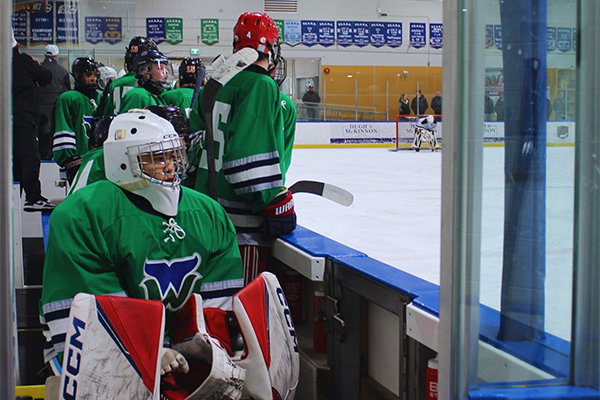
When 45+ skaters and 8 goalies took the ice at the White Rock Whalers Junior ID Camp, they weren’t just competing for roster spots, they were being tracked by the same sensor-based analytics technology used to evaluate elite hockey talent across North America.
The Whalers organization was fresh off their dominant 2026 Pacific Cup Championship run with a 12-1-1 playoff record and partnered with DRIVE to bring professional-grade player evaluation to their identification camp. The result? Every stride, every shift, every decision captured, quantified, and analyzed.
What Players & Goalies Actually Received
This wasn’t a generic skills combine. Drive’s patented Smart Arena sensor infrastructure tracked every participant in real-time, generating comprehensive performance profiles across four critical categories:
- Fitness Metrics — Endurance capacity, recovery rates, and sustained effort levels throughout gameplay
- Skating Performance — Top speed, acceleration bursts, edge work efficiency, and skating mechanics
- Situational Performance — Positioning intelligence, zone coverage, and decision-making under pressure
- Game Impact — Contribution to offence, defence, and overall team value
Players and goalies also opted in to receive a full AI-generated analytical report, a detailed assessment synthesizing thousands of individual data points into actionable development insights. No guesswork. No subjective bias. Just data-driven evaluation of what happened on the ice.
“On-site leaderboards compared ID camp participants directly against the 2025-26 Whalers roster, showing exactly where each player stacked up against a championship-caliber team.” cited DRIVE Hockey’s Daniel Stewart.
Why ID Camps Are Embracing Sensor Analytics
For organizations running identification camps, the challenge has always been evaluation consistency. Scouts see different shifts. Coaches remember different moments. Bias creeps in.
Drive’s technology solves this by capturing every player, every second, on every shift—then applying AI analysis to surface patterns human observation misses. The Whalers coaching staff received a complete ranking of all participants, benchmarked against their current roster’s performance data.
For players, the value is equally clear: objective feedback on exactly where they stand and what specific skills need development to reach the next level.
The Bigger Picture: Combines Across North America
The White Rock Whalers ID Camp joins a growing list of elite hockey organizations leveraging Drive’s analytics platform. This April, DRIVE returns to Green Bay for USHL Combines, marking the third consecutive year the technology is being used to evaluate top junior prospects at one of hockey’s most competitive developmental showcases.
With fall evaluation season approaching, arena partners and hockey organizations across the U.S. and Canada are already booking DRIVE’s services for their own camps, combines, and tryouts.
The Future of Player Evaluation
Hockey development is evolving. The days of clipboard scouting and gut-feel evaluations aren’t over, but they’re being augmented by sensor data and AI analysis that sees what human eyes can’t and gives actionable feedback to players and parents based on actual measured benchmarks.
For the 45+ players who took the ice at the Whalers ID Camp, that future is already here. And for the organizations smart enough to embrace it, the competitive advantage is undeniable.
